Programação
-
-
Meet Naledi
Naledi is a librarian at a community library in Johannesburg. She has spent months building a digital OER collection she is proud of. But when a visually impaired patron asks for help finding learning materials, she realises none of her resources have alternative text, audio descriptions, or large print options. When a new community member arrives who does not speak English fluently, she notices the collection offers nothing in local languages.
The resources are there. But not everyone can use them.
In this module, we explore what it really means to make OER accessible and inclusive, and how you as a librarian can ensure your collection works for everyone, regardless of ability, identity, or circumstance.
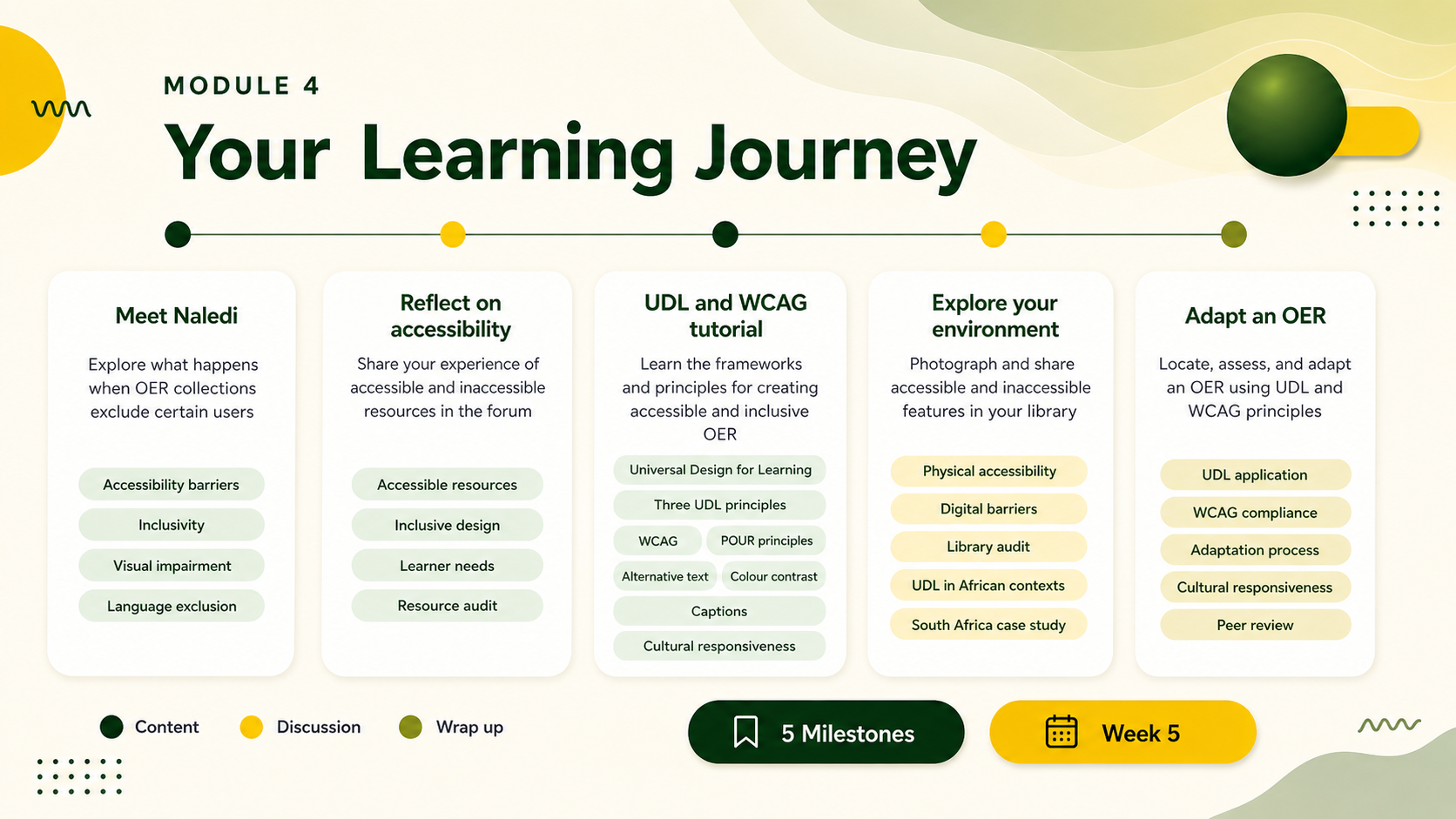
What you'll learn in Module 4
- Apply Universal Design for Learning principles to evaluate and adapt OER for diverse learners.
- Use Web Content Accessibility Guidelines to assess and improve the accessibility of digital OER in your library context.
-
Cor de fonte
Tipo de fonte
Font Kerning
Tamanho da fonte
Visibilidade da Imagem
Espaçamento entre letras
Altura da Linha
Destaque do link
Paragraph Width
Text Alignment
Cor do texto